

On March 13, 2026, and effective immediately, the United States Patent and Trademark Office (USPTO) published a notice of “Supplemental Guidance for Examination of Design Patent Applications Related to Computer-Generated Interfaces and Icons” in the Federal Register (“Supplemental Guidance”), with application to all design patent applications filed before, on, or after March 13, 2026. In short, the Supplemental Guidance establishes that when the title and claim identify a computer, computer system, or computer display panel as the article of manufacture, there is no longer a requirement to depict that article of manufacture in the drawing or drawings to ensure that a claimed design of a computer-generated interface or icon for that article of manufacture is patent-eligible subject matter. The Supplemental Guidance also opens the door for standalone design protection of projected, holographic, and virtual and augmented designs that appear on or are generated by an electronic device.
The Supplemental Guidance is based on a significant change in the USPTO’s position on the eligibility of computer-generated interfaces and icons under 35 U.S.C. § 171, with the apparent goal being to provide additional flexibility to applicants to obtain design protection for computer-generated interfaces and icons in the U.S. This updated position comes after significant engagement between the USPTO and U.S. design patent system stakeholders over the past six years. As we posted about here, the consensus among major intellectual property organizations like the International Trademark Association (INTA) and the American Intellectual Property Law Association (AIPLA) had been that no additional conditions or requirements should be necessary for projected, holographic, and virtual or augmented designs to be design patent eligible. Major aspects of the Supplemental Guidance are briefly outlined below.
Importantly, the Supplemental Guidance eliminates the requirement that the drawings must depict an underlying article of manufacture (e.g., a computer, computer display, or portion thereof) in solid or broken lines to render a screen-generated design patent eligible, but retains the requirement that both the application title and claim should continue to properly identify an article of manufacture. This change does away with the legal fiction that it is necessary to depict a “display screen” as a box around the design to establish that said design is “for” an article of manufacture and therefore patent-eligible, as required by 35 U.S.C. § 171, and provides applicants with greater flexibility in presenting digital designs in U.S. design patent applications.
Next, the Supplemental Guidance instructs examiners to recognize that a title or claim indicating that a digital display is “for” a computer, computer system, or computer display panel adequately describes a patent-eligible design “for” an article of manufacture and not a design per se that may not be protected under the design patent system. To clarify what is and is not acceptable, the Supplemental Guidance provides a non-exhaustive list of phrases that adequately describe a digital design for an article of manufacture under 35 U.S.C. § 171: “computer screen with an icon,” “display panel with GUI,” “display screen or portion thereof with icon,” “portion of a computer screen with an icon,” “portion of a display panel with an icon,” “portion of a monitor displayed with an icon,” “icon for display screen,” “GUI for display panel,” “projected interface for a computer,” “virtual reality interface for a computer,” “augmented reality interface for a computer” and “computer icon.”
The Supplemental Guidance also reinforces the requirement that a sufficient number of views must be provided to fully disclose the claimed design, as the requirements of 35 U.S.C. §§ 102, 103, and 112 still need to be met and remain unchanged by the Supplemental Guidance. For two-dimensional icons or interfaces this may be a low bar, but in the context of three-dimensional designs such as projections, holograms, and virtual or augmented reality designs, applicants should consider the views that are sufficient to fully disclose the design, even if the article of manufacture itself is not shown in the drawings.
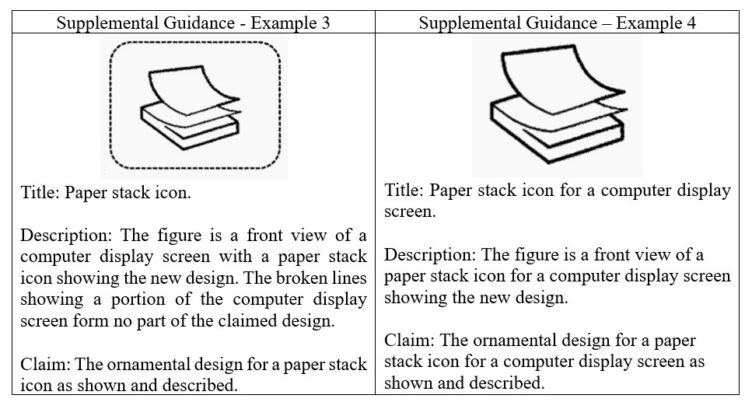
To assist applicants, practitioners, and examiners in complying with the changes in the Supplemental Guidance, twelve useful examples are provided to illustrate how the article of manufacture requirement should be applied to computer-generated icons and interfaces under 35 U.S.C. § 171 and the related regulations (i.e., 37 C.F.R. § 1.153(a) (or 37 C.F.R. § 1.1067(a)) and 37 C.F.R. § 1.152). The examples clarify that it is only necessary that the title, description, and claim identify the article of manufacture using one of the sufficient phrases, while the drawings need only depict the computer-generated interface or icon in as many views as is sufficient to fully disclose the claimed scope. As shown in Example 3 below, although the drawing depicts a computer display screen in broken lines, the title and claim fail to identify any article of manufacture and, thus, the example is not compliant. In contrast, Example 4 is compliant because each of the title, description, and claim recite the article of manufacture, even though the drawing does not depict an article of manufacture.
Finally, and arguably most importantly, the Supplemental Guidance directly recognizes the eligibility of projected, holographic, and virtual and augmented reality (“PHVAR”) designs under the current statute (35 U.S.C. § 171) and caselaw. As established by the CCPA in In re Hruby in 1967, the fact that the existence of PHVAR designs depends on something outside itself, e.g., a computer, does not necessarily mean that such a design is not a design for an article of manufacture and therefore directly within the language of the statute. This change represents a major shift in the USPTO’s position and one that had been advocated by several major commentators, including AIPLA and INTA.
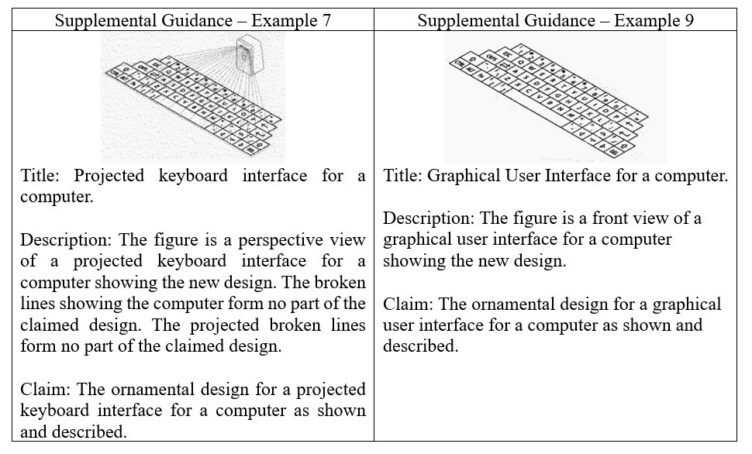
As provided in Examples 7-11 of the Supplemental Guidance, projected and holographic user interfaces and virtual/augmented reality-based designs are patent-eligible subject matter under 35 U.S.C. § 171 when the title and claim properly identify the underlying article of manufacture. In fact, the comparison between Examples 7 and 9 below demonstrates that applicants need not use specific terminology, such as “keyboard,” to describe the digital designs, as long as the title and claim describe a “graphical user interface” or similar phrasing for a recognized article of manufacture, e.g., a computer.
The Supplemental Guidance represents a material step in the right direction for the USPTO and stakeholders interested in design protection for computer-generated interfaces, icons and PHVAR designs, but this progress is not without uncertainties to be resolved by future USPTO guidance or legislation. To preserve rights, applicants may want to include a list of various design phrases and articles of manufacture in the description or appendix to permit continuing applications to be pursued.
The Quarles design rights legal team is nationally recognized for its extensive knowledge and practice experience in this complex and important field. For questions about this article or how to incorporate design-related legal rights into your intellectual property portfolio, please contact the author(s) of this post directly or send a message to the team via our Contact page. To subscribe to our mailing list and receive updates that highlight issues currently affecting the design rights legal field, click here.